

Playgrounds change with the families who use them. What schools, churches, HOAs and recreation departments ask for today looks different from the playgrounds many communities installed a generation ago, and the decisions that matter most are often made long before anyone picks out a slide.
This guide covers the playground trends shaping new outdoor projects and the groundwork that turns them into a space people actually use: how to divide the site by age, what to put underfoot, where shade goes and how to plan for the adults who bring the children.
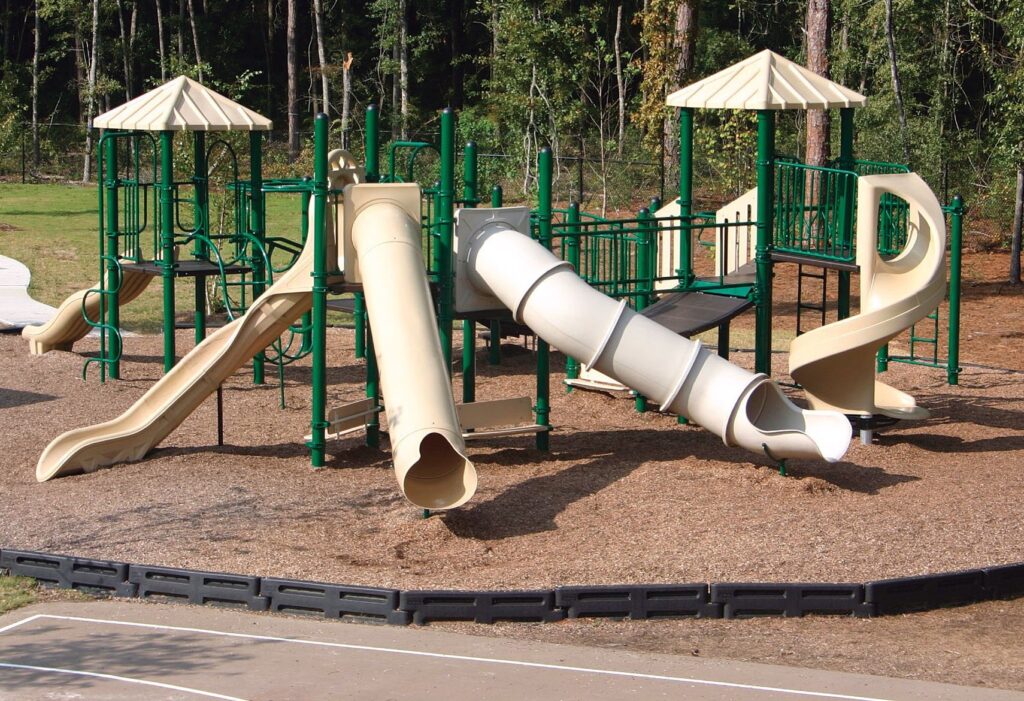
Separate Play Areas for Different Ages
One of the clearest shifts is away from one large structure meant for every age. More owners now plan separate structures for younger and older children, typically one for ages 2 to 5 and another for ages 5 to 12. Toddlers get low platforms and gentle slopes where bigger kids will not run them over, and older children get enough height and challenge to stay interested.
Separate areas also make supervision easier, because a parent watching a three-year-old can stay beside the smaller structure instead of scanning a crowded tower. Public playground guidance from the U.S. Consumer Product Safety Commission recommends separating play areas for different age groups, and a walkway, a row of benches or a planting bed makes a natural buffer between them. Our outdoor playground equipment comes in ranges for ages 2 to 5, 5 to 12 and 2 to 12. If the budget covers only one structure this year, plan the site so the second can be added later without tearing anything out.
Surfacing Is Getting Its Own Line in the Budget
Many older playgrounds sat on whatever loose fill was cheapest to spread. Today, facilities are replacing worn ground cover with rubber mulch, synthetic turf or poured-in-place rubber, or choosing those materials from the start. Each has a different upfront cost and a different upkeep routine:
- Poured-in-place rubber forms a seamless surface that suits wheelchairs and strollers and needs little day-to-day care, at a higher initial cost.
- Synthetic turf over a cushioning pad stays green all year and does not scatter.
- Rubber mulch cushions well but has to be raked back into place where feet and slide exits push it aside.
- Engineered wood fiber usually costs the least upfront, and it needs regular raking and topping up to keep its depth.
Surfacing is one of the larger items in a playground budget and one of the easiest to underestimate. Some designers combine materials, using a unitary surface on the accessible route and under the busiest equipment and a loose fill elsewhere, so more of the money goes into play. Whatever you choose must be rated for the fall height of the equipment above it. Compare the options on our playground safety surfacing page.
Shade Has Moved From Extra to Expected
In much of the country, an unshaded playground sits empty through the hottest part of the day. Slides, decks and seats in direct summer sun can get too hot to touch, so families wait until evening or go somewhere else. Shade over the play area, picnic tables and seating changes that pattern and protects skin at the same time.
Plan shade early, because posts and footings need room that equipment and use zones may already claim. Look at where the sun sits during the hours the playground will be busiest, not only at noon, and remember that the adults need shade too. Explore our shade structures and park shelters for play and picnic areas.
Natural Materials and a Sense of Place
Designers are seeing growing interest in natural play: wood elements, boulders, logs, plantings and features that connect a playground to its surroundings. Wood stays more comfortable to the touch than metal on a hot day, and it suits parks and nature-focused schools. Wooden playgrounds fell out of favor years ago, partly over concerns about the chemicals once used to treat the wood. Natural play today relies on wood species and finishes chosen for outdoor use.
The other half of this trend is placemaking. Instead of a stock structure dropped onto a lawn, owners want a playground that reflects its setting: a theme drawn from local history, colors that match the school or a layout that works around the trees already on site. Natural elements can sit alongside a conventional structure, so you do not need to pick one approach for the whole site.
Laying the Groundwork for the Whole Site
Too often the playground is the last item in a renovation, squeezed into whatever space is left. The projects that work best treat the play area as part of the whole site from the beginning. Before choosing equipment, plan for these:
- Trees. Keep mature trees where you can and plant more. They give shade no structure can match and soften the edges of the play area.
- The ground itself. Gentle slopes, mounds and earth berms add play value and can define the edge of the space in place of some fencing. A grassy mound with a slide set into the slope is a simple example.
- The adults. Benches with a clear view of the equipment, picnic tables, trash receptacles and shaded paths make families stay longer. Where the site allows, nearby food or coffee gives grown-ups a reason to linger.
- Access and drainage. An accessible route from parking to the play area, and ground that drains after rain, prevent problems that are costly to fix later.
- Future phases. Reserve space and a budget line for a second structure, more shade or a sport court later on.
Plan for Cleaning and Upkeep From Day One
Busier playgrounds draw more attention to how clean and well kept they are, so build a simple routine into the plan. For everyday cleaning, soap and water applied with a garden hose at low pressure is the usual recommendation. High-pressure washers can strip paint and damage plastic surfaces. Before using any disinfectant or chemical cleaner, check with the equipment manufacturer, because some coatings and plastics react badly to certain products.
Add regular walk-throughs to look for loose hardware, worn surfacing and damaged parts, and keep a record of what you find. Problems caught early are cheaper and easier to fix.
Frequently Asked Questions
Should we buy one large structure or separate ones for each age group?
If both preschoolers and school-age children will use the playground, separate structures usually serve both groups better. Younger children get equipment sized for them, older children get more challenge, and adults can supervise more easily. When the budget is tight, a site plan that reserves room for the second structure lets you build in phases.
When should we start planning a new playground?
As early as possible, ideally before the overall site plan is final. Shade footings, surfacing, drainage and the accessible route all depend on site work, and they cost more to change once concrete and utilities are in place.
Plan Your Playground With A-OK Playgrounds
A-OK Playgrounds is a family-owned company in Austin, Texas that designs, supplies and installs commercial playgrounds, with 3D design and site planning to help you see the layout before you commit. Call 512-826-8800, email [email protected] or request a quote to start planning. Digital catalogs are available on request.