

A tennis court is a long-term amenity. Built well, it serves a resort’s guests, a club’s members, a company’s staff or an HOA’s residents for many years, and it gives an organization a place for lessons, leagues and events that few other amenities can match.
This post looks at tennis court construction as an investment: what a court can do for a business or community, how to plan the space and choose a surface, and how to care for the court so the investment holds its value.
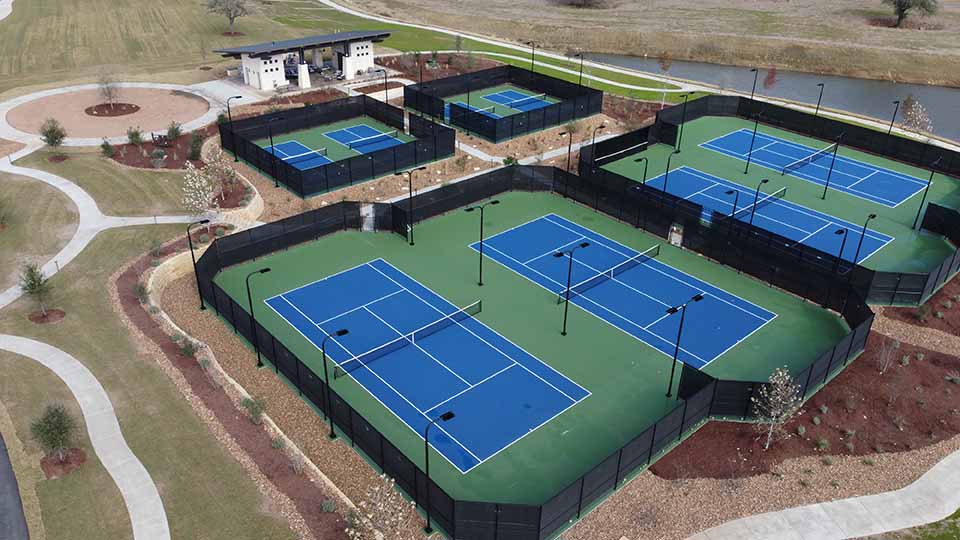
What a Tennis Court Can Do for Your Organization
The value of a court depends on who it serves. A few common cases:
- Resorts, hotels and clubs can offer guests and members an activity that fills mornings and evenings, and a base for lessons, clinics and tournaments.
- Corporate campuses can support staff wellness and give teams a place to meet outside the office, from casual games after work to company tournaments.
- HOAs and apartment communities can add an amenity that residents notice when choosing where to live, and one that brings neighbors together.
- Schools and parks can support physical education, team practice and public play.
Tennis also suits a wide age range. Children can start on smaller courts with slower, lower-compression balls, while adults can play competitively for decades. That broad reach is part of what makes a court a durable investment rather than a passing trend.
Planning the Footprint
The lines of a doubles tennis court measure 78 feet long by 36 feet wide. The playing area extends well beyond those lines, because players need room behind the baseline and beside the sidelines to reach the ball. A common planning footprint for one court, including that run-off space, is about 60 by 120 feet. Courts built side by side can share fencing and some of the space between them.
Other early decisions shape the project:
- Orientation. Tennis courts are usually aligned north to south so the low sun is not directly in a server’s eyes.
- Grading and drainage. The court needs a stable, well-drained base and a slight slope so rain runs off. Water collecting under or beside a court is a common cause of cracks and low spots.
- Access. Construction equipment needs a way in, and players need a clear, accessible path from parking to the court gate.
- Neighbors. Light and sound reach beyond the fence, so consider nearby homes or guest rooms when choosing the site.
Choosing a Court Surface
The surface decides how the ball bounces, how the court feels underfoot and how much care it needs.
Hard courts
Most community and commercial courts in the United States are hard courts: an acrylic coating system over asphalt or concrete. They play consistently, need relatively little daily care and suit most players. Post-tensioned concrete, a slab with steel cables tensioned inside it, is often chosen by owners who want a court built to resist cracking over the long term.
Cushioned hard courts
Adding cushioned layers beneath the acrylic finish softens the surface. It is easier on knees and joints, which matters for clubs and communities with older or frequent players.
Clay and other soft courts
Soft courts slow the ball down and are gentle on the body, but they need regular watering, rolling and brushing. They suit clubs with grounds staff. They are rarely the right fit for an HOA or office campus without daily maintenance help.
Amenities That Complete the Court
- Fencing and windscreens keep balls on the court, cut the wind and give players a clean backdrop for tracking the ball.
- Lighting lets members and residents play after work and in cooler evening hours, which matters in hot climates.
- Seating, shade and water near the gate give players a place to rest between sets and spectators a place to watch. A park shelter beside the court also gives lessons and events a home base.
- Storage for ball machines, baskets and teaching equipment helps if you plan to run lessons.
Getting a Return on the Court
For a business, the return on a tennis court is rarely measured by the court alone. It shows up in guests who extend a stay, members who renew, residents who choose to stay, or employees who join wellness programs. A few practices help a court pull its weight:
- Offer programs, not just a court. Lessons, clinics, round robins and social events give people a reason to come back.
- Make booking simple, so the court is easy to use whenever it is free.
- Use the court for events, such as client days, community tournaments or fundraisers.
- Keep it looking cared for. A clean, well-lit court with crisp lines says something about the whole property.
Schools, churches, HOAs and municipalities working within a budget cycle or grant timeline can explore financing and leasing options from A-OK Playgrounds, built around fiscal years and approval timelines.
Protecting the Investment Over Time
Routine care keeps a hard court playing well for years:
- Blow or sweep off leaves and debris often. Organic matter left on the surface stains it and holds moisture.
- Keep drains and the ground around the court clear so water moves away.
- Check the net, center strap and posts, and keep the net at 3 feet at the center.
- Watch for cracks and have them addressed while they are small.
- Keep bikes, skateboards, chairs with sharp legs and anything else that can gouge the coating off the court.
Over time the acrylic finish wears and fades, and the court will need to be resurfaced and restriped. Planning for that from the first year keeps it a budgeted maintenance item rather than a surprise.
Frequently Asked Questions
Can a tennis court also be used for other sports?
Lines for other games can be added, but every extra set of lines makes the court a little harder to read for tennis players, and shared use means shared hours. If tennis is the main purpose, keep the layout simple. If demand for another sport grows, a separate court is often the better long-term answer.
Should we light our tennis court?
If the people you serve are mostly free in the evening, lighting can greatly increase how much the court is used. Plan the wiring during construction, even if fixtures come later, and think about light spill toward neighbors.
Talk With A-OK Playgrounds About Your Court
A-OK Playgrounds is a family-owned company based in Austin, Texas that works with businesses and communities on sport courts and athletic facilities, tennis courts among them. Call 512-826-8800, email [email protected] or request a quote. Digital catalogs are available on request.