

Pickleball has grown from a backyard pastime into one of the most requested amenities at parks, community centers, apartment communities, churches and clubs. Players of almost any age can learn it in an afternoon, and a court takes up a fraction of the space of a tennis court.
If your organization is weighing whether to build pickleball courts, this post covers why the investment makes sense, what makes a court good to play on, and the planning questions that are easy to miss, from noise to lighting to how many courts to build.
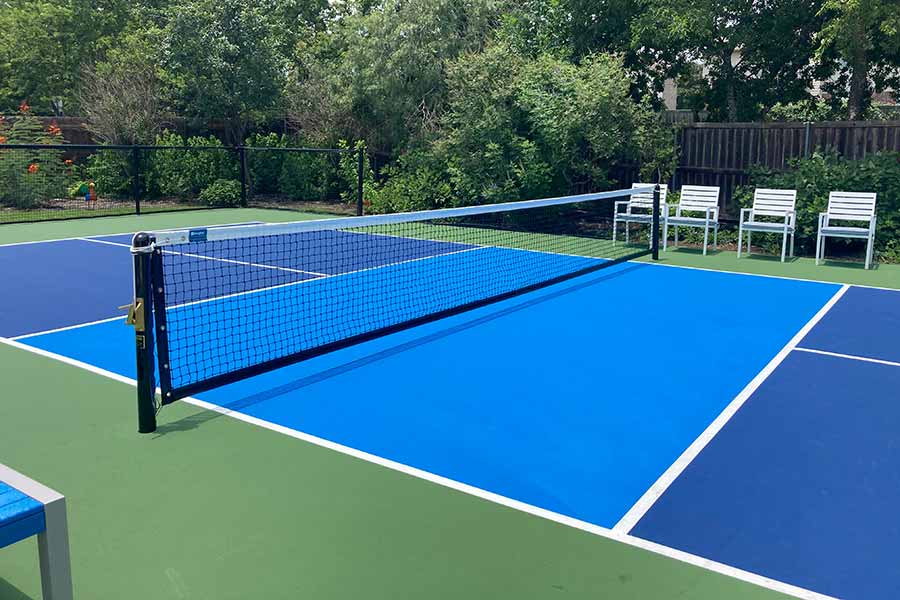
Why Organizations Are Adding Pickleball Courts
The case for pickleball rests on a few practical strengths.
- It is easy to start. The paddle is light, the ball moves slower than a tennis ball, and the serve is hit underhand. New players can rally on their first visit.
- It spans generations. Teenagers, working adults and retirees play the same game, often together. That makes courts useful for families and for residents of every age.
- It is social. Most play is doubles, and open-play sessions, where players rotate in and out between games, mix people who did not arrive together. The court becomes a gathering place.
- It keeps people moving. The game involves steady footwork, quick reactions and short bursts of movement, at a pace many people can keep up for an hour or more.
- Demand is already there. In many communities, players wait for open courts or drive across town to find one. A local court answers a request residents and members are already making.
A Small Footprint That Serves Many Players
A pickleball court measures 20 by 44 feet, the same size as a doubles badminton court. A non-volley zone, often called the kitchen, extends seven feet from the net on each side. Even with clear space around the lines for players to move, the total area is far smaller than a tennis court, and several pickleball courts can fit on the footprint of a single tennis court. That is why parks and clubs often turn an underused tennis court into a bank of pickleball courts.
For a new build, think in terms of court banks rather than single courts. Two or more courts side by side share fencing, lighting and seating, serve more players at once and make leagues and open play practical. A single court tends to fill up quickly and leave people waiting at the gate.
Dedicated Courts or Shared Lines?
Painting pickleball lines on an existing tennis or basketball court is the quickest way to test interest. It works for light use, but it has limits. A tennis net sits higher at the center than a pickleball net, the extra lines can confuse players of both games, and different groups end up competing for the same hours.
Dedicated pickleball courts avoid those conflicts. They carry permanent nets set at the correct height, 36 inches at the sidelines and 34 inches at the center, and only their own lines, so the court is always ready to play. If pickleball is already drawing steady crowds on borrowed lines, that is a strong sign dedicated courts will be used.
Design Details That Make a Better Court
- Orientation. Outdoor courts are usually laid out with the long axis running north to south, so players are not looking straight into a low morning or evening sun.
- Surface. Most outdoor courts use a textured acrylic coating over concrete or asphalt, which gives a consistent bounce and good footing. Modular tile systems over a sound slab are another option.
- Fencing and dividers. Perimeter fencing keeps balls near the court, and lower dividers between side-by-side courts stop balls rolling into the next game.
- Windscreens. The perforated plastic ball is light and drifts in the wind, so windscreens help on exposed sites.
- Lighting. Many players are only free in the evening, and lights turn those hours into playing time.
- Shade, benches and water. Open play means waiting between games. A shade structure over seating near the gate keeps people comfortable and makes rotating in and out easy.
Plan for Sound Before You Pick the Site
Pickleball has one well-known drawback: the sharp pop of a hard paddle hitting a plastic ball carries farther than many people expect. Courts placed close to homes have led to complaints in some communities. It is far easier to deal with in planning than after opening:
- Choose a location with as much distance from homes and bedroom windows as the site allows.
- Use buildings, landscaping or other structures as a barrier between courts and neighbors.
- Consider sound-dampening panels on the fence lines that face residences.
- Set reasonable hours of play and post them at the entrance.
For HOAs and apartment communities in particular, talking with nearby residents early tends to make the whole project smoother.
Making the Investment Pay Off
A court earns its keep through use. Organizations that get the most from new pickleball courts usually plan programs alongside construction:
- Beginner clinics that bring new players in.
- Scheduled open play grouped by skill level.
- Leagues or ladders for regular players.
- A simple reservation system for the busiest hours.
For clubs, gyms and some apartment communities, courts can support memberships, rentals or lessons. For parks, HOAs and churches, the return is participation and a stronger sense of community. Either way, budgeting for upkeep, such as cleaning, net replacement and eventual resurfacing, protects the investment. If funding is the hurdle, schools, churches, HOAs and municipalities can ask about financing and leasing from A-OK Playgrounds, planned around grant cycles, budget years and the approvals a board or council needs.
Frequently Asked Questions
How much space does a pickleball court need?
The court itself is 20 by 44 feet. You also need clear space beyond the lines on every side so players can move safely, plus room for fencing, gates and seating. The total depends on whether you build one court or a bank of courts side by side.
Can we add pickleball lines to our tennis court?
Yes, and many organizations start that way. It is a low-cost way to gauge interest, but a shared court means shared schedules and a net set for tennis. If pickleball use keeps growing, dedicated courts are usually the next step.
Is pickleball too noisy for a residential community?
It can be if courts sit close to homes. Distance, barriers, sound-dampening panels and posted hours all help, but site selection matters most, so make that decision with noise in mind.
Start Your Pickleball Court Project
A-OK Playgrounds, a family-owned company in Austin, Texas, helps organizations plan sport courts and athletic facilities, including dedicated pickleball courts. Call 512-826-8800, email [email protected] or request a quote to talk through your site. Digital catalogs are available on request.