

A playhouse looks simple: four walls, a door and a couple of windows. To a young child it is a stage, a meeting room and a hideaway all at once, which is why early childhood classrooms so often keep a pretend play corner. This guide is for parents and educators who want to understand what children actually practice inside a playhouse, and how to set one up so those benefits show up in everyday play.
You will find the main areas of development a playhouse supports, what each one looks like in real play, and practical ideas for getting more out of the space at home, in a classroom or in a childcare center.
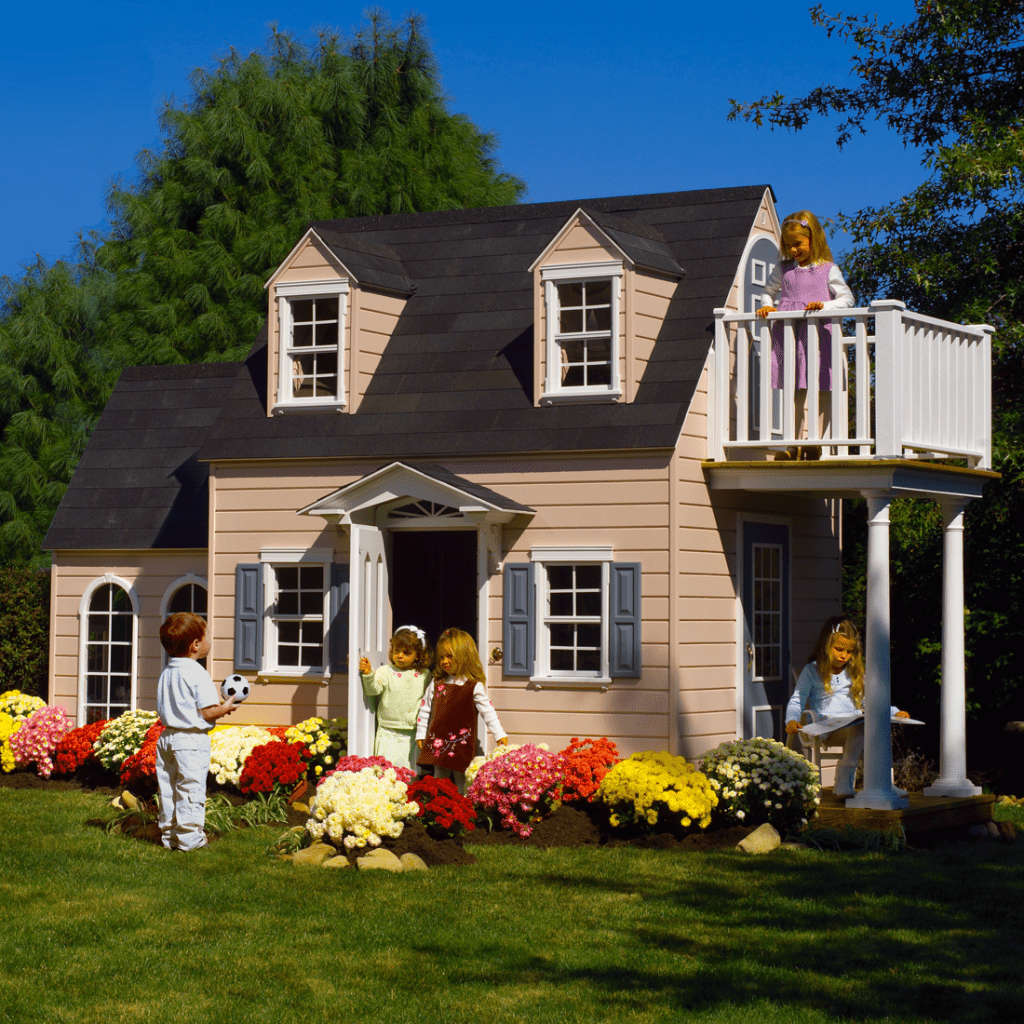
Pretend Play Builds Thinking Skills
When a child decides the playhouse is a bakery, a fire station or a ship, they are doing real mental work. They hold an idea in mind, assign roles, let one object stand for another and keep a story going from start to finish. A block becomes a loaf of bread and a windowsill becomes a service counter. This kind of symbolic thinking is an early building block for reading and math, where letters and numerals stand for sounds and quantities.
Pretend play also asks children to plan and adjust. “First we cook, then the customers come, then we close the shop” is a sequence. When a friend changes the plot, the child has to adapt without abandoning the game. Child development researchers often link this give and take to self-regulation: the ability to wait, stick to the rules of a role and manage impulses. A playhouse gives that practice a natural home, because the walls and the door signal that a game is under way.
A Small Space for Big Social Lessons
A playhouse holds only a few children at a time, and that limit is useful. Small groups make it easier for a quieter child to join in and harder for one loud voice to run the whole game. Inside, children negotiate constantly:
- Who plays which role, and whether roles can switch halfway through
- How to share a limited set of props, such as one toy phone or one cash register
- What happens when two children want the story to go in different directions
- How to welcome a newcomer, or how to ask to join a game already in progress
Playing the parent, the shopkeeper or the doctor also lets children try on someone else’s point of view. Acting out how a customer feels when an order is wrong, or how a parent comforts a crying baby, is early practice in empathy. Adults can support this by naming what they see, such as “You gave your friend a turn at the counter, that was kind,” rather than stepping in to direct the game.
Language and Early Literacy
Pretend play tends to be talkative play, because the game only works if everyone knows what is happening. Children narrate (“I’m making soup”), give directions, argue their case and borrow words from adult life: receipt, appointment, delivery, recipe. A playhouse invites that vocabulary when it comes with a few simple props:
- A chalkboard or whiteboard for menus, prices and open and closed signs
- A mailbox with envelopes, scrap paper and crayons for writing letters
- A small shelf of picture books for a reading nook theme
- Clipboards, order pads and play money for a shop or restaurant theme
Educators can rotate the theme every few weeks, moving from post office to grocery store to veterinary clinic, and tie it to what the class is learning. Each new theme brings a fresh set of words. Children who are not yet writing still practice holding a crayon and “writing” orders, which is an early step toward literacy.
Movement, Coordination and Body Awareness
Not every benefit is about thinking and talking. Moving in and around a playhouse builds physical skills in small, steady doses. Toddlers practice ducking through a doorway, stepping over a threshold and judging how much room their bodies need. Opening shutters, turning a play knob or working a latch exercises the small hand muscles children later use for buttons, scissors and pencils. Carrying play dishes from the kitchen to the table without dropping them is coordination practice disguised as a game.
Some playhouse designs add a porch, a step or a low climbing element, which brings in balance and larger movements. Any raised part should match the age group using it and sit over suitable safety surfacing.
A Place to Recharge
Busy classrooms and busy homes can be a lot for a young child. A playhouse offers a sense of “this is our place,” which many children find calming. A child who needs a break from a noisy group can retreat to the playhouse, play quietly with a doll or a book, and rejoin the others when ready. Learning to notice “I need a minute” and to take that minute is a valuable emotional skill.
The goal is privacy without isolation. Children should feel tucked away, but adults still need a clear view. Open windows and a wide doorway let a parent or teacher supervise without hovering.
Setting Up a Playhouse for Different Ages
The same playhouse can serve children at several stages, but the way you set it up should change as they grow.
Toddlers
Keep it low, open and simple. Toddlers enjoy doors and windows to open and close, a few sturdy props and plenty of floor space. Leave out small parts that could be a choking hazard. In childcare rooms, indoor toddler play pieces built for this age group pair well with a playhouse.
Preschoolers
Children of about 3 to 5 are in the prime years for elaborate pretend play. Add theme props, dress-up clothes and simple writing materials, and rotate them so the play stays fresh.
School-Age Children
Older children use a playhouse more like a clubhouse: a base for planning games, reading and talking with friends. Give them a say in how the space is arranged and decorated, which builds the same sense of ownership in a more grown-up way.
Frequently Asked Questions
Is an indoor or outdoor playhouse better for development?
Both support the same kinds of play. An indoor playhouse works well as a classroom learning center or a year-round play corner, while outdoor playhouses add fresh air, daylight and room for bigger, louder games. Many centers use one of each.
Should adults join in the play?
Briefly, yes. Joining for a few minutes to model a new role or introduce a prop can spark richer play. Children get the most out of it when the adult then steps back and lets them lead, so watching is often more useful than directing.
What safety points matter most?
Look for smooth, rounded edges, no openings that could trap fingers or heads, and doors that cannot latch shut with a child inside. Outdoor units should be anchored. For a playhouse at a school, daycare or other shared setting, ask which safety standards it is designed to meet; ASTM International publishes the standard used for public playground equipment.
Plan Your Playhouse with A-OK Playgrounds
A-OK Playgrounds is a family-owned company in Austin, Texas that helps schools, daycares and churches choose playhouses and playroom designs that fit their children and their space. To talk through the options, call 512-826-8800, email [email protected] or request a quote. Digital catalogs are available on request.